What changed on 5 November
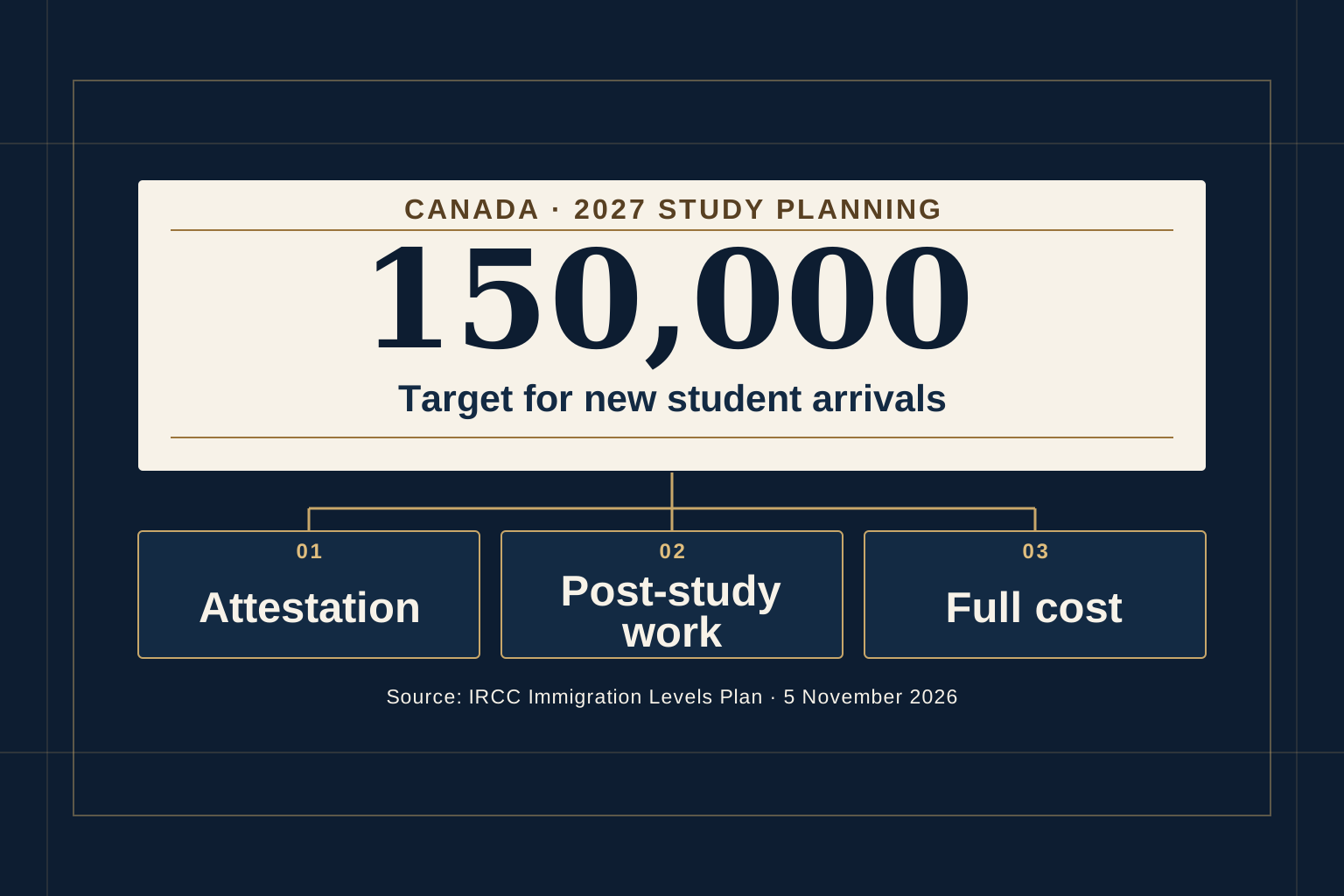
Immigration, Refugees and Citizenship Canada (IRCC) released its 2027–2029 Immigration Levels Plan on 5 November 2026. It sets a target of 150,000 new international student arrivals in 2027 and lists the same figure for 2028 and 2029, with those later targets subject to annual review. The previous plan had already pencilled in 150,000 for 2027. The new release confirms that figure and extends the planning horizon to 2029. The 2026 target was 155,000; that comparison is between targets, not observed arrivals.
This is a plan for future years. Its release on 5 November did not itself change the documents a student must submit, launch a new work permit route or assign a quota to a particular university. If you are choosing a January or September 2027 intake, the immediate decision is whether your particular offer can become a complete, affordable application on the timetable the school gives you. Source review: 6 November 2026.
Keep the three numbers separate
The first number is the national target for new student arrivals. IRCC counts arrivals in its published statistics using permit issuance and excludes extensions. The number therefore should not be read as a count of border crossings. The second is total study permit issuance, which can include extensions. IRCC’s separate 2026 allocation notice illustrates the difference: it expected up to 408,000 permits, including 155,000 for new arrivals and 253,000 extensions. Those are 2026 planning figures. They do not give us a 2027 issuance total.
The third number is how many applications can enter processing under the applicable cap. Attestation letters are part of that system for applicants who need them. The levels plan does not tell an applicant how many such spaces a province or school will have in 2027. It also gives no denominator for calculating your chances of admission or permit approval. Ask the school when it expects to confirm the attestation process for your intake and when you can file a complete application. Keep any quoted allocation dated and tied to its cap year.
Check the credential before the deposit
Start with the exact credential on the offer, the teaching campus, and the designated learning institution (DLI) number. Under the current rules, a student applying for a degree-granting master’s or doctorate at a public DLI can use the federal provincial or territorial attestation letter (PAL/TAL) exemption introduced on 1 January 2026. A graduate certificate offered by the same institution does not qualify for that exemption simply because it is taught after a bachelor’s degree. An undergraduate applicant should generally plan for a PAL/TAL unless an applicable exemption covers their case.
If you need a PAL/TAL, ask the school what triggers its request, whether a deposit is required, what happens if a letter cannot be issued, and when you can recover the deposit. An admission letter and an attestation letter serve separate purposes. Submit the attestation with the permit application when required. The letter is linked to the school, and a 2026 PAL/TAL generally expires by 31 December 2026, or earlier if the document says so. It must be valid when you apply. A 2027 start date does not let you carry a 2026 PAL/TAL into a new cap year.
Quebec has its own process for the Quebec Acceptance Certificate (CAQ). Confirm the applicable CAQ and federal documents even when a graduate programme qualifies for the federal PAL/TAL exemption. The CAQ also has different validity and reuse rules. If you already hold a study permit and are extending at the same DLI and same level, check the separate federal exemption for that situation. A change of school or level needs its own document review.
Test the post-graduation work route programme by programme
A DLI can offer programmes with different post-graduation work permit (PGWP) outcomes. Verify the specific credential and delivery arrangement against IRCC’s DLI list and PGWP guidance. For bachelor’s, master’s and doctoral degree graduates under current rules, the language threshold is Canadian Language Benchmarks (CLB) 7 in English or Niveaux de compétence linguistique canadiens (NCLC) 7 in French in all four abilities, with no PGWP field-of-study requirement. A university admission test or language waiver does not establish that you will have the accepted evidence for a later PGWP application.
For a college diploma or certificate in IRCC’s college and other non-university category, check the exact six-digit Classification of Instructional Programs (CIP) code against the official list if you file your study permit application on or after 1 November 2024. The current language threshold for that category is CLB or NCLC 5 in all four abilities. For other university programmes outside the three degree categories, the current language threshold is CLB or NCLC 7, and the same filing date triggers the field requirement. Ask for the code and credential in writing: similar course titles can lead to different codes, and a public college’s name is insufficient if the programme is delivered through a curriculum licensing arrangement.
Work permit duration is a separate check. An eligible master’s degree of at least eight months (or 900 hours for Quebec programmes) can qualify for a three-year PGWP, subject to all requirements and passport validity. Other eligible programmes shorter than two years generally yield up to their own length, subject to IRCC’s conditions. The general eligibility rules include full-time study, with an allowance for part-time study in the final semester, and applying within 180 days of confirmation of completion. Your study permit must also have been valid at some point during the 180 days after completion. Check any exceptions separately. Build a document calendar before graduation; the ceremony date is a poor substitute for the date your school confirms completion.
Compare two data science degrees through a family budget
The University of British Columbia describes its Vancouver Master of Data Science as a ten-month programme with a mentored capstone. Waterloo’s full-time co-op Master of Data Science and Artificial Intelligence can be completed in 16 months, including a four-month work term; an extended work term can lengthen it. The shorter course concentrates coursework and a project into less time. Waterloo’s co-op format offers a different way to build experience, with more time in Canada and a work term to plan around. Compare the actual curriculum, placement process, fees and likely living costs; neither a project nor a co-op label guarantees a job.
For the student, both are master’s degree formats whose published durations clear the eight-month threshold for the current master’s PGWP duration rule. Each student must still verify the programme and meet the remaining conditions. For a spouse or common-law partner, the comparison is different. Under the current student-spouse work permit rules, the master’s category requires a programme of at least 16 months, along with the other requirements, including the student holding a valid study permit. Waterloo’s published 16-month format clears that duration condition if it is the format confirmed on the offer. UBC’s ten-month format does not clear it. Doctoral and specified professional or other eligible programmes have separate routes.
Use the university’s official duration and enrolment documents rather than the time a student personally expects to spend in Canada. If the household needs a partner’s salary to meet rent, price both offers with zero partner income and ask how long you could sustain the longer course. A possible open work permit removes one obstacle to employment; it does not supply a wage, a start date or a job offer.
Set a cash limit before you pick an intake
For applications from 1 September 2026, IRCC lists CAD 23,448 in first-year living expenses for one person outside Quebec, and CAD 29,192 for two, excluding tuition and transport. Recheck the table at filing. The permit application must show available resources without relying on work in Canada. For programmes longer than one year, IRCC also wants to know how you will fund the rest of the course. Quebec has separate financial requirements.
Use those figures to assess the evidence you need, then build a separate household budget using actual rent, insurance, travel, tuition and fees. For example, with first-year tuition of CAD 35,000 and transport of CAD 2,000, a solo applicant using the current outside-Quebec living-expense figure would need to account for CAD 60,448 across those three items. These tuition and transport figures are illustrative. Budget extra for exchange-rate moves, a housing deposit and the period between finishing the course and finding paid work.
For a funded research offer, read the funding letter term by term. Separate guaranteed funding from assistantships you must win later, deduct tuition and mandatory fees, and check whether funding continues in the summer. Set a maximum amount you can afford to lose on deposits, travel and housing if the intake slips. An inexpensive programme with a large non-refundable commitment before the permit file is ready can expose more cash than a pricier offer with clear deferral terms.
Use these checks before you accept
Ask the school for one written answer covering the exact credential, campus, DLI number, official duration, attestation process or exemption, and refund and deferral dates. Cross-check the response with IRCC. Where a programme has a field requirement, record the CIP code and the date you checked it. If you need a co-op placement to make the degree worthwhile, ask how placements are secured and what academic options exist if you do not find one.
Work backward from the last date you can start classes. Mark when the acceptance letter and any attestation will be available, when your funding documents will be ready, and when the deposit becomes non-refundable. If those dates do not line up, ask for a deferral or keep a viable second option before paying. Avoid booking non-refundable travel based on an application submission or a school’s estimated timeline.
Finally, judge the course against a career plan that still works if you leave Canada after studying. Name two plausible roles, identify the modules, projects or work experience that would prepare you for them, and compare what the qualification is worth in another labour market. The levels plan gives you useful context about the size of future intakes. Your decision rests on the evidence for the offer you can afford and the career it can support.
Admissions, visa and immigration rules can change. Always verify time-sensitive requirements on the relevant government and university websites before acting.
Primary sources reviewed
Official references
- IRCC: 2027–2029 Immigration Levels Plan and student arrival targets
- IRCC: student and temporary worker statistics and 5 November release date
- IRCC: previous 2026–2028 Immigration Levels Plan
- IRCC: 2026 provincial and territorial allocations and permit issuance
- IRCC: PAL/TAL exemptions, validity and Quebec CAQ rules
- IRCC: designated learning institutions and eligible programme information
- IRCC: PGWP eligibility, language and completion requirements
- IRCC: PGWP field of study and CIP codes
- IRCC: PGWP duration and passport validity
- IRCC: work permits for spouses and common-law partners of students
- IRCC: proof of financial support and living-expense table
- University of British Columbia: Vancouver Master of Data Science and capstone
- University of Waterloo: full-time MDSAI co-op programme and duration
Information reviewed on 6 November 2026. Time-sensitive rules should be checked again before application, deposit and enrolment.